

You told yourself you wouldn’t do it again.
Then the familiar moment arrived - a direct question about your work, one more request on an already full week, a Slack message that said “Can we talk?” - and there you were. Defensive, saying yes, spiraling.
You know the pattern. You might even know where it came from. You don’t want the same outcomes. And still, it runs.
So you think to yourself, maybe late at night, “Why am I the way I am? What’s wrong with me?”
But an outcome you don’t want isn’t proof that something is wrong with you. It’s evidence of a system doing exactly what it learned to do.
You’re running on an operating system you can’t see
You don’t watch your phone’s operating system while you scroll, right? You don’t even think about it. You only notice it when something freezes, crashes, or keeps throwing the same error.
You have a personal operating system too - it’s the mostly invisible, interconnected set of beliefs, values, expectations, emotional patterns, protective strategies, learned behaviors, and past experiences that influences what you notice, what you make things mean, and how you respond.
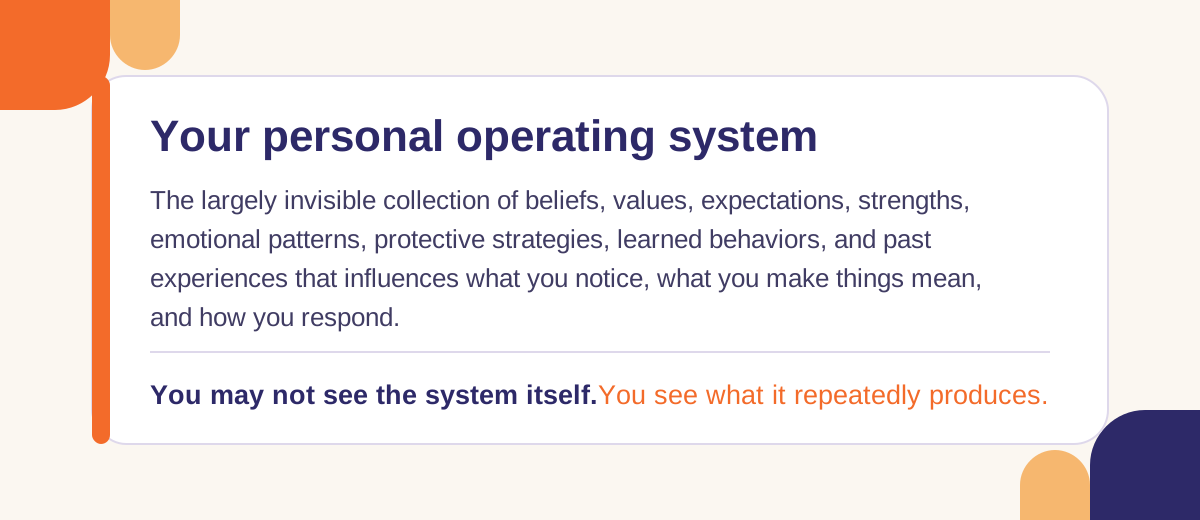
It shapes what you notice, what you ignore, what meaning you give things, what happens within you and what you do.
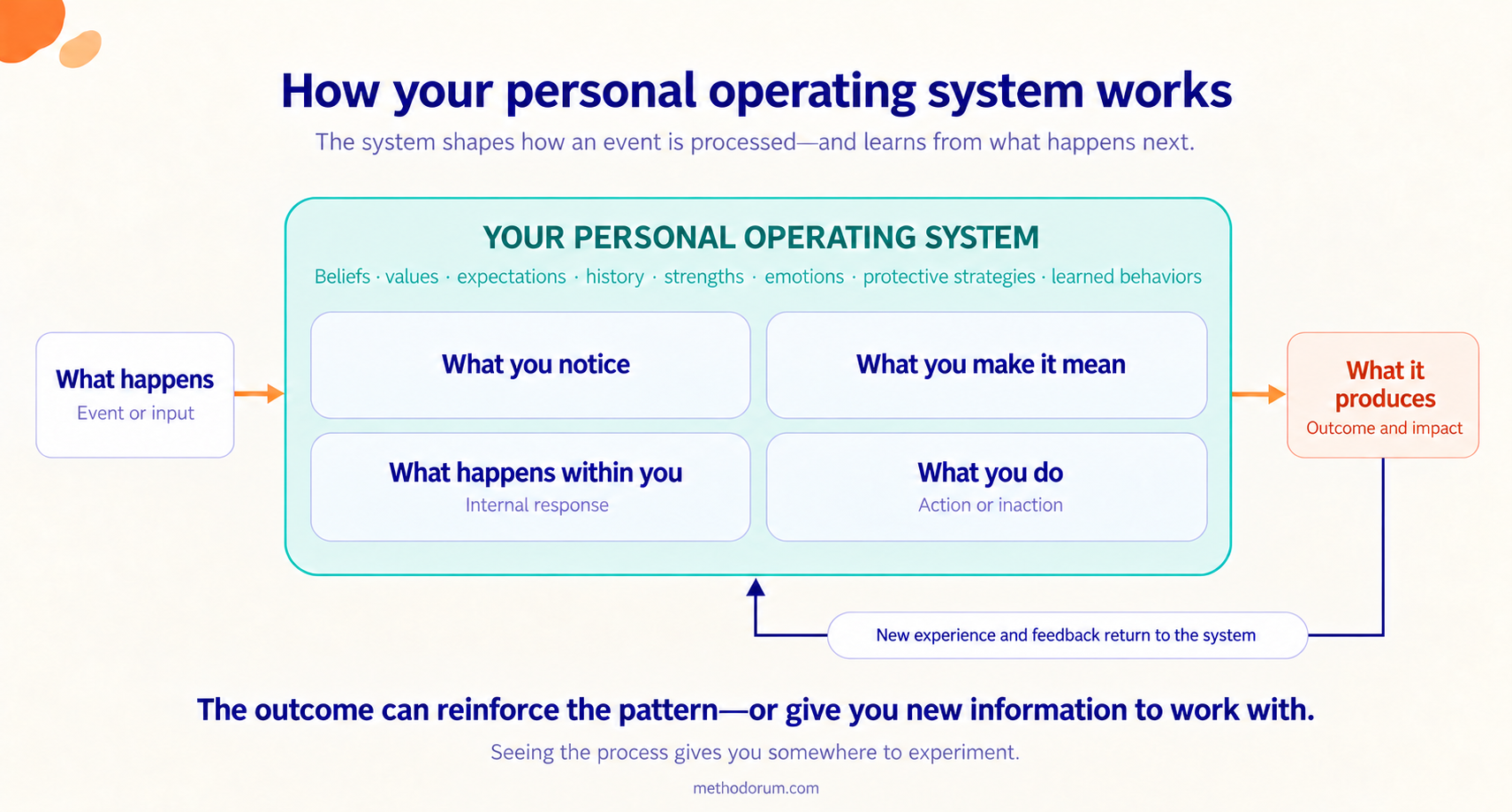
It runs a chain so fast it feels like a single reflex:
What happens → What you notice → what you make it mean → what happens within you → what you feel compelled to do → what you do → what that keeps producing (outcomes)
Everything between what happens and what it produces is your operating system in motion. What it produces is the outcome - the impact on you, other people, and what happens next.
You may not see the entire chain, but you can usually see parts of it, especially what you do and what it produces. Because those visible parts are often all we notice, it’s easy to read them as a verdict about who we are instead of evidence of a larger operating system beneath them. And so you think, I’m lazy, I’m too sensitive, I always screw this up, I’m never good enough. Or a verdict on someone else like, They’re impossible, they don’t care, they’re jerks.
Either way, we stop at the person and miss the system producing the pattern.
Looking at your own system doesn’t excuse someone else’s harmful behavior or make you responsible for it. It just shows you what happens inside you when that behavior arrives, and which choices are still yours.
Nobody designed their system on purpose
You didn’t sit down at age six and decide how you'd respond to conflict, criticism, or being ignored. You learned it - from family, culture, school, work, and whatever you had to get through. You noticed what earned approval and what cost you, and you adapted.
Many of those adaptations were brilliant. Staying quiet kept the peace at home. Anticipating every problem kept you safe in an unpredictable environment. Being useful earned you belonging.
The issue is that systems keep running what they learned long after the environment changes. So the kid who kept the peace becomes the manager who can’t voice disagreement. The one who scanned for danger reads every setback as a calamity. The one who earned love by being useful says yes to everything, then quietly resents everyone for asking.
If jumping in to rescue failing projects early in your career is what got you noticed, promoted, and trusted, you’ll probably keep doing it. But you might get to a point where you now lead a team of twelve, and every difficult problem still lands on your desk. So your team has learned to wait for your direction. And you think your team lacks ownership, whereas they think you don’t trust them. Nobody is wrong about what they see, and nobody is looking at the system one learned pattern built across an entire team.
Repeat a pattern long enough and it stops feeling like something you learned. It starts feeling like who you are AND how the world works.
Same input, different system, different output
Two people get the same message from the same manager -
“Hey, can we talk at 3?”
One accepts the invite and keeps working. The other feels her stomach drop, rereads it four more times, replays every mistake from the week, and spends the rest of her afternoon worrying.
The message didn’t land in an empty space. It landed in two different operating systems, each shaped by a different history with authority, feedback, and job security.
And the same person can respond differently years apart. The one whose stomach dropped might, six years later, barely blink. Maybe she’d have better managers, survived hard feedback, and built confidence in her work. Her system would’ve taken in new information and updated.
Which means our operating systems are not fixed.
The behavior isn’t the whole system
Most self-improvement tips go straight to the behavior. Procrastinating? Get a planner. Time-block. Try harder.
But procrastination isn’t always a discipline problem. Research suggests it often works as a way to escape the uncomfortable feelings a task stirs up - ambiguity, self-doubt, the fear of revealing you don’t know something you should. Avoiding the task brings you temporary relief which in turn reinforces the avoidance. The deadline finally forces a panicked finish. Then you call yourself lazy and buy a nicer, more expensive planner.
Procrastination is the visible behavior. But inside the system, there’s a bunch of feelings, beliefs, expectations and learned responses that all may be interacting to influence that behavior. Focus only on stopping the behavior and you may miss what keeps generating it.
For example:
-
Your behavior: you avoid working on the project
-
Immediate internal outcome: you feel relief
-
Later personal outcome: your anxiety increases as the deadline approaches
-
External outcome: the work is delayed, someone has to compensate
-
Feedback to your system: avoidance provided relief and produced no immediate consequence serious enough to stop it, making the system more likely to repeat the behavior
Your operating system includes how you process and act. The outcome is what that way of operating produces. Sometimes the outcome is immediate, and sometimes it takes time to compound. Either way, it becomes new information that can reinforce the existing pattern or give you a reason to question it.
And all that mostly happens without you even noticing.
The sentence that made my operating system visible
Years ago, I went to my boss to complain about another team. They weren’t following up. They weren’t doing what we’d agreed to. I wanted him to make them step up.
He told me, “Whenever you’re frustrated, it’s about you, not anyone else.”
I was baffled. And honestly, a little annoyed. Their lack of work and alignment were real!
But he wasn’t saying they didn’t matter or that the breakdown was my fault. He was pointing out that my frustration was being produced inside me. And that gave me somewhere to look besides at them.
I realized that I had to separate observable events from my verdict - what happened from my interpretation or story about what happened. I had to separate content from context.
So I broke the situation down:
-
What happened: They missed several follow-ups, didn’t respond to any email, and didn’t complete work we’d discussed.
-
What I noticed: Only what they hadn’t done and how it was hurting my team
-
What I made it mean: They don’t care. Someone needs to make them do their jobs.
-
What happened in me: Growing frustration and tunnel vision on their failures.
-
What I did: Complained upward and waited for someone else to fix it.
-
What it produced: Nothing changed. I stayed stuck. The team still wasn’t performing. Resentment was growing on both teams.
Everything from what I noticed through what I did was my operating system in motion. “Nothing changed, staying stuck, non performance and resentment” were the outcomes it produced.
From there, I asked two more questions: What outcome do I want? What can I do to help make it happen? That instantly gave me back my agency - my ability to play a role to influence the outcome, regardless of what was happening.
My approach changed. And so did our results as a cross-functional team.
That’s observability - the ability to see what a system is actually doing, not what we assume it’s doing. Engineers employ this frequently with software - they infer a system's internal state by examining external outputs. For you - your inner experience is one source of information. Your observable behavior is another. So are the outcomes it produces, how other people experience you, and the patterns that repeat across different situations. You might never see all of it, but you can see enough to find a part to work on.
Seeing is not the same as changing
You can understand exactly why you get defensive and still get defensive. Awareness isn’t a switch.
Personality research also demonstrates that even though our traits are fairly stable, simply wanting to change them does little on its own. But research also suggests that intentional interventions and repeated practice can produce changes that last.
So the goal isn’t to install a new personality. It’s to experiment with one part of the system and collect new evidence about what that produces so that you can see, learn, and implement new ways of being and doing over time.
Read the system. Then change one part.
Change doesn’t require you to fix your entire personality. Just start with one reaction, behavior, or repeated outcome you want to understand. Read the system, get some external data points, then choose one point and experiment with it.
To read your operating system, ask yourself (like I did after the frustration realization):
-
What happened? Describe the observable event without explaining or judging it
-
What did I notice and what might I have overlooked?
-
What did I make it mean? Here’s where bring in your assumptions, conclusions, judgments, or story about it
-
What happened within me? Notice your thoughts, feelings, physical sensations and impulses
-
What did I do? Actual behaviors/reactions
-
What did that produce? The outcome you got as a result
Once you answer those questions, seek out external information that may not be visible from inside your own system. Get someone else’s perspective, ask what they saw from their vantage point. What might someone else have observed? How did they experience my behavior? Where else does this pattern show up? What feedback or repeated outcome have I been explaining away?
Now choose one point in the chain and experiment with it. Ask yourself:
-
What is the outcome I want?
-
What can I do to make that happen?
Do it. Practice it. Observe what happens. See what, if anything changes in you and outside of you. Reflect on it. Modify what you do if need be. Practice again. And so on, and so forth, until you hone it and repeat it enough times that it becomes part of your operating system.
Maybe you check an assumption before treating it as a fact. Or ask a question before reacting, pause when you notice a familiar physical response, try another way of communicating, change one condition in the environment, even use one of your strengths more deliberately.
Then observe what the change produces.
One attempt tells you what happened once. It’s just an anecdote. Repetition helps you see whether the change produces a different pattern.
Keep what helps. Revise what doesn’t Try again.
Your operating system isn’t defective software to rip out and replace. It’s the way you learned to operate - full of all the adaptations that protected you, the strengths you may not recognize, and the responses so automatic they feel inevitable.
But automatic doesn’t mean unchangeable.
You won’t control every thought, feeling, person, or outcome. But you can see more of what’s operating beneath your responses. And that’s where your choices begin.

Understand yourself. Achieve your goals.
Most of what you do runs on autopilot, shaped by beliefs you picked up long ago. This free 4-step workbook helps you see how your mind works, decide what you really want, and take the first real step toward it.
- Assess what's really going on
- Redefine what you want
- Re-envision your future
- Make it happen
Get new posts by email
Practical ideas on leading yourself and your team. Unsubscribe anytime.