

I once worked with a really smart, articulate, well-liked leader.
She managed two functions that, if they worked together toward a shared goal, would've move the needle on revenue in a real way. Everyone knew it. The numbers were right there on the dashboard.
But inside her team? Confusion. Infighting. Two function heads moving in completely opposite directions.
How is that possible?
Well, she doesn’t like confrontation and doesn’t want to rock the boat. She wants people to like her, so she keeps things vague. She’ll tell each person what she thinks they want to hear. Swimlanes go undefined, goals are loosely articulated, and big decisions perpetually deferred. At the same time, she talks a big talk and manages up beautifully. But she won’t draw lines in the sand, and won’t sit in the discomfort of pushback or disagreement.
So what fills that vacuum? How do things get done?
Each function head defaults to what they know best - their own way of operating. One cares about the direct line to revenue. The other cares about a different set of metrics. They’re all important but nobody’s aligning them. Nobody’s made the call. Resources get stretched, messaging becomes inconsistent, priorities clash, and slowly, quietly, the team stops operating like a team. Turfs emerge. Decisions get made without looping in the other side. Conversations go underground. Smiles get exchanged in team meetings while misalignment runs rampant in the hallways - MI6 and CIA type covert operations, double agents, informants. And a goal, because it was never clearly articulated, may or may not have been reached depending on who you ask.
Revenue? Negatively impacted. But you’d never know.
What shows up on the dashboard are missed targets - some of the operational metrics. Maybe slipping engagement scores. Maybe customer churn. Maybe less traffic to the site. Less conversions. Nothing that points here though. Nothing that names her conflict avoidance as a root cause. Nothing that traces the covert operations back to the vacuum she created. The data on the dashboard is real. It’s just not the whole picture.
This is what an operating system looks like when you finally see it .
Not broken people. Not bad intentions. Not the wrong hires or the wrong strategy. Just a pattern, running by default, producing exactly the results it was set up to produce.
And if you look closely, you’ll see that there wasn’t just one operating system in that room. There were three.
There’s the individual OS - the patterns, beliefs, behaviors, and blind spots each person carries. Her conflict avoidance isn’t a personality flaw. Her brain is doing exactly what brains do: predicting and protecting based on what it’s learned over time. Her system was built to keep her safe, to preserve relationships, to avoid the pain of disapproval. It’s working perfectly. It’s just costing her company revenue.
Then there’s the team OS - what shows up when individual operating systems interact without shared direction. Her function heads aren’t sabotaging each other. They’re filling a vacuum the only way they know how, each defaulting to their own logic, their own priorities, their own definition of winning. Nobody designed this dynamic. Everyone adapted to it.
And then there’s the organizational OS - the norms, the unspoken rules, the informal patterns that calcify over time when nobody names them. The MI6 dynamic doesn’t stay in one team. It becomes how things work here. New people join and absorb it. Leaders above it mistake the smiles for alignment - that inference becomes part of the system too. And the system keeps producing the results it was designed to produce, whether anyone likes it or not.
These three layers don’t operate in isolation. They interact, compound, and reinforce each other every single day. And almost none of it shows up in your BI tool.
This is the part where most leaders, especially analytically-minded, data-driven ones, check out. Because this sounds like soft skills territory. HR stuff. Not the kind of thing that moves a revenue number.
I’d push back on that directly.
If you’re working from an incomplete data set, you are not being data-driven. You’re being selectively data-driven. And selectively data-driven is actually worse, because it gives you the confidence of rigor without the accuracy. You’re making high-stakes decisions about headcount, strategy, structure, and resources based on a fraction of what’s actually driving results.
The behavioral patterns are data. The informal workarounds are data. The unspoken rules about whose voice matters are data. The dynamic where two functions smile in meetings and run covert operations in the hallways is data. It’s just not in your dashboard, because dashboards only show you what you’ve already decided to measure.
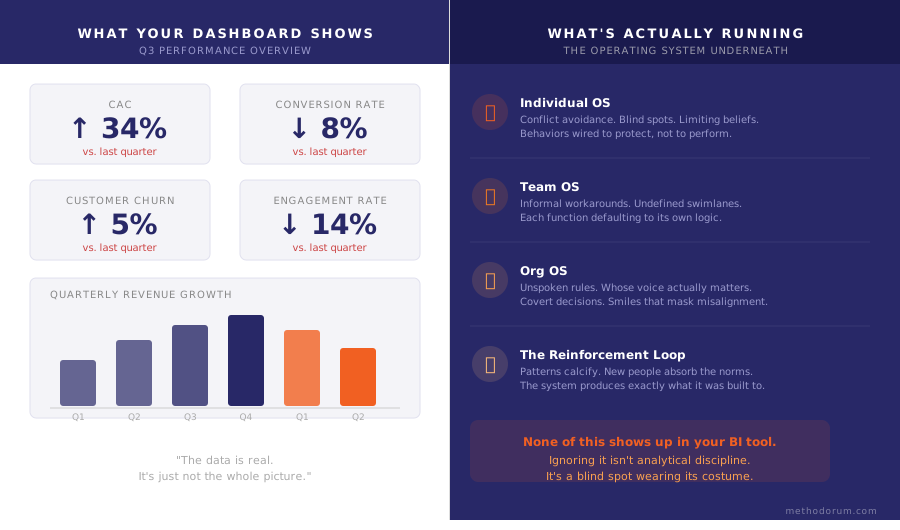
Ignoring it isn’t analytical discipline. It’s a blind spot wearing the costume of discipline. So if your targets keep slipping, if your team is working hard but something keeps getting lost between effort and outcome, if you’ve adjusted strategy and the headcount and the OKRs and the tools and nothing has fundamentally changed - this is why. You’re treating the tip of the iceberg. The system underneath it is still running exactly the way it was built to run.
Shifting your results means shifting the system. And shifting the system starts with being willing to see it - all of it. Not just what’s in the slide deck.
That’s where we begin if we want different outcomes. And if you want to know where your system is actually producing results right now, the Results Gap Diagnostic will show you. It’s free, takes about 5 minutes and it’ll show you what’s running, where you’re strong, and where to focus first to shift outcomes.
Because you can’t change what you can’t see.
Get new posts by email
Practical ideas on leading yourself and your team. Unsubscribe anytime.